Doll Therapy for Dementia: Why Can a Doll Bring Comfort and Connection?
Tabla de Contenidos
- 1. What Is Doll Therapy for Dementia?
- 2. Why Might a Doll Create an Emotional Response?
- 3. Emotional Connection Can Remain When Memory Changes
- 4. “But Isn't Giving an Older Adult a Doll Infantilizing?”
- 5. Does Someone Have to Carry the Doll All Day?
- 6. The Caregiver Matters More Than the Doll
- 7. What Does the Research Say About Doll Therapy?
- 8. What If the Person Doesn’t Want the Doll?
- 9. Dignity Must Always Come First
- 10. Looking Beyond the Doll
- 11. Frequently Asked Questions About Doll Therapy for Dementia
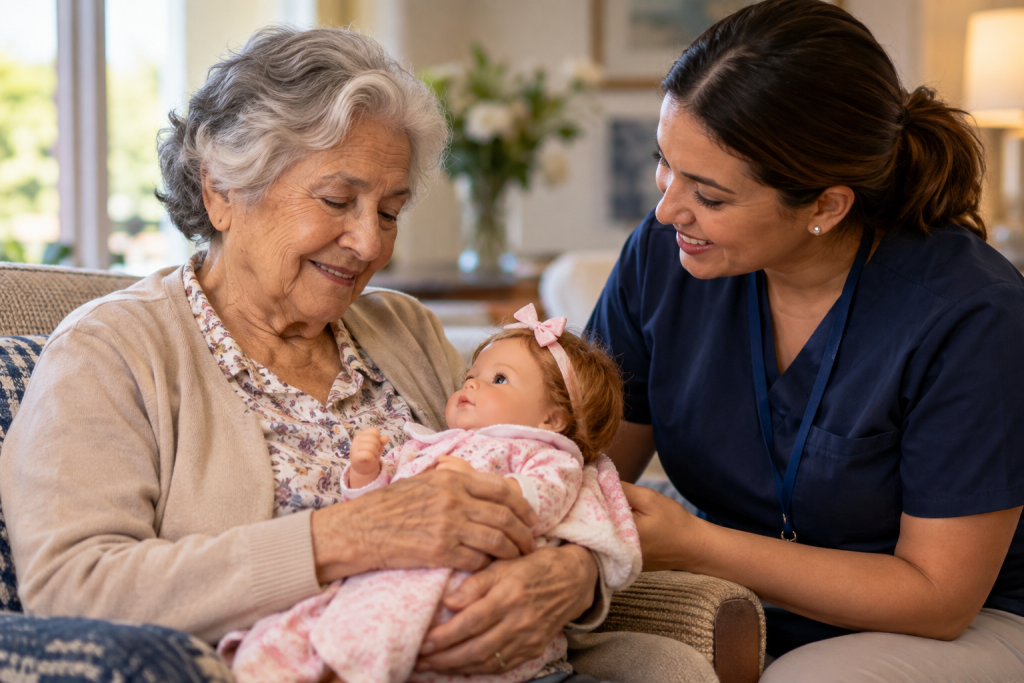
Imagine an older woman who has spent much of her life caring for others. Today, she is living with dementia and sometimes finds it difficult to communicate what she needs or how she feels.
During a therapeutic activity, she is offered a doll.
She looks at it, carefully takes it into her arms and adjusts its clothing. A few moments later, she smiles and begins to speak.
Someone observing from a distance might see only one thing:
An older adult holding a doll.
But a dementia care professional may see something very different: an emotional response, an opportunity for connection and a moment worth understanding.
This is the idea behind doll therapy for dementia, a non-pharmacological, person-centered intervention that has been studied particularly among people living with moderate to severe dementia.
And no, its purpose is not to treat an older adult like a child.
Understanding that distinction changes the entire conversation.
What Is Doll Therapy for Dementia?
Doll therapy involves introducing a human-like doll and observing whether interacting with it creates a positive response for a person living with dementia.
Some people may hold the doll. Others may speak to it, cradle it, adjust its clothing or simply enjoy having it nearby. Some may become more communicative or appear calmer.
Others may show absolutely no interest.
And that is perfectly valid.
The goal is not to make someone interact with a doll. The goal is to discover whether the interaction is meaningful to that individual.
Doll therapy belongs to a broader group of non-pharmacological approaches used in dementia care. These approaches focus on supporting emotional well-being, engagement and quality of life without relying solely on medication.
Research has reported promising results. A systematic review involving seven studies and 295 participants found improvements in emotional state and communication and reductions in some challenging behaviors. The authors also emphasized that larger, more rigorous studies are still needed.
That last point matters.
Doll therapy is not a cure for dementia, and it should never be presented as one.
Its potential value lies somewhere much more human.
Why Might a Doll Create an Emotional Response?
Dementia can affect memory, language, orientation, perception and the ability to understand one’s surroundings.
But cognitive decline does not erase the human need for comfort, connection, security, affection and purpose.
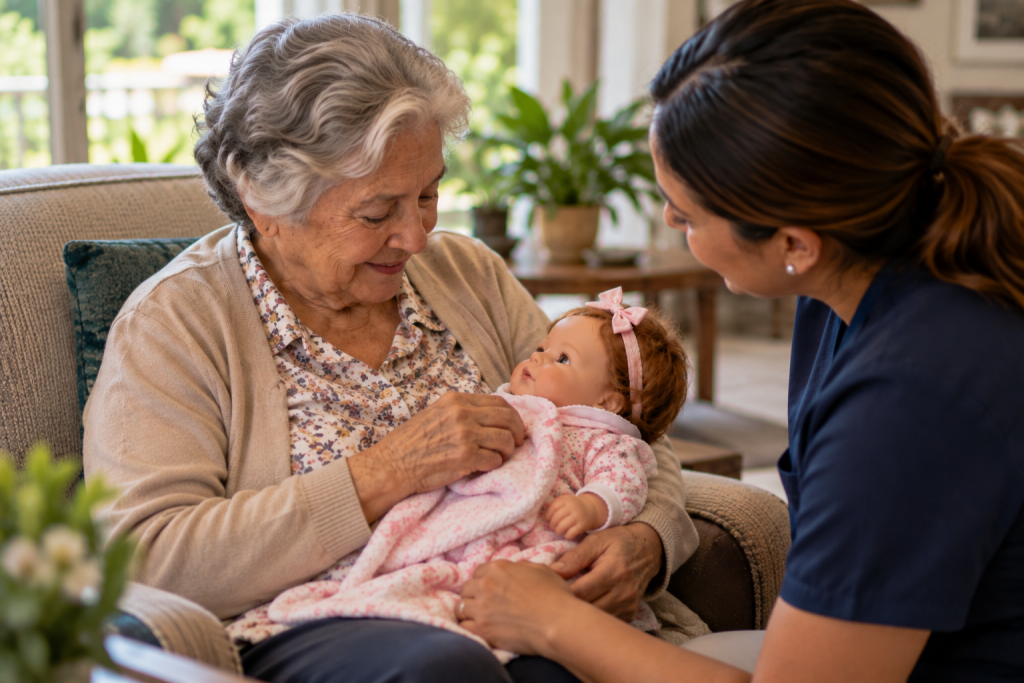
For some people, holding a human-like doll may encourage nurturing or caregiving behaviors. A person who rarely initiates conversation may begin speaking. Someone experiencing restlessness may become more settled. Another person may simply smile while holding the doll.
Research has explored these responses through concepts such as attachment and caregiving behavior. In one randomized controlled trial involving 134 women with moderate-to-severe dementia living in nursing homes, participants receiving a structured doll therapy intervention showed reductions in behavioral and psychological symptoms compared with a control intervention, while also demonstrating greater caregiving and exploratory behaviors toward the doll.
But perhaps the easiest way to understand the idea is not through statistics.
Imagine that someone has increasing difficulty telling you:
I feel lonely.
I need something familiar.
I want to take care of something.
I need reassurance.
A meaningful activity may sometimes allow an emotion to be expressed even when finding the right words has become difficult.
The doll is not necessarily important because of what we think it represents.
What matters is what the interaction appears to mean to that person.
Emotional Connection Can Remain When Memory Changes
One of the most important lessons in dementia care is that abilities do not simply disappear all at once.
Someone may struggle to remember a recent conversation but still respond to a familiar song.
A person may have difficulty naming family members but experience warmth when seeing them.
Someone may no longer be able to explain why an activity matters to them and still clearly show enjoyment, comfort or interest while doing it.
That is why meaningful dementia care cannot focus exclusively on asking:
“What does this person remember?”
We also need to ask:
“How does this person feel?”
What brings comfort?
What creates engagement?
What encourages communication?
What helps this individual feel safe, useful or connected?
For one person, the answer might be music.
For another, gardening.
It could be photographs, folding familiar items, art, gentle movement, spending time outdoors or interacting with an animal.
And for some people, it may be a doll.
That does not mean they have “become children again.”
It means an activity has produced a meaningful response.
“But Isn't Giving an Older Adult a Doll Infantilizing?”
This is probably the most important—and most understandable—question surrounding doll therapy.
The concern deserves a serious answer.
A person living with dementia is still an adult.
Their diagnosis does not erase their life story.
It does not erase the relationships they have built, the people they have loved, the work they have done, their personality or their right to be treated with dignity.
For this reason, infantilization and dignity are genuine ethical issues discussed in the professional literature on doll therapy. Researchers have considered the intervention through principles including autonomy, well-being, dignity and the possibility of causing distress.
How the intervention is used therefore matters enormously.
A doll should not simply be pushed into someone’s arms.
A person should not be instructed to “play.”
They should not be spoken to as though they were a child.
And a dementia diagnosis should never be used as a reason to assume that someone wants a doll.
Instead, caregivers can introduce an opportunity and observe the person’s verbal and non-verbal response.
If there is interest, that interest can be explored.
If there is rejection or discomfort, it should be respected.
Person-centered dementia care begins with the person—not the activity.
Does Someone Have to Carry the Doll All Day?
No.
This is another common misconception.
Using doll therapy does not necessarily mean giving someone a doll and expecting them to carry it throughout the day.
It can be a structured or occasional therapeutic interaction.
A caregiver or therapist may introduce it during a particular activity or at a moment when engagement could be beneficial. The person’s response can then guide what happens next.
Research itself has examined structured interventions rather than simply assuming permanent access to a doll. For example, controlled studies have used defined sessions led by caregivers or trained staff.
Some individuals may develop a positive attachment and voluntarily want the doll nearby more often. Others may enjoy a brief interaction and then move on to another activity.
Both responses can be appropriate.
This is why the question should not simply be:
“Does doll therapy work?”
A much better question is:
“Is this interaction helping this particular person?”
That is the difference between applying an activity automatically and practicing truly individualized care.
The Caregiver Matters More Than the Doll

A doll sitting on a chair is not therapy.
The most valuable part of the interaction may be what happens between the person and the caregiver.
Suppose a resident who has been relatively quiet begins talking while holding the doll.
A thoughtful caregiver can use that moment to connect.
They can listen.
They can respond.
They can observe the resident’s expression and body language.
Perhaps the interaction opens a conversation. Perhaps it evokes nurturing behavior. Perhaps it simply creates a peaceful moment shared between two people.
In that sense, the doll can sometimes function as a bridge to human interaction.
It should never become a replacement for it.
A person living with dementia still needs meaningful relationships, conversation, appropriate stimulation, movement, companionship and genuine human presence.
Good dementia care is not about placing an object in someone’s hands and walking away.
It is about discovering what helps that individual engage with the world around them.
What Does the Research Say About Doll Therapy?
The evidence is encouraging, but responsible dementia care requires us to describe it accurately.
A 2022 systematic review concluded that doll therapy appeared to improve emotional state and communication while reducing some disruptive or aggressive behaviors among people with dementia. However, the researchers noted limitations in the available studies and called for larger randomized trials with stronger methodology.
A later systematic review and meta-analysis, published in Geriatric Nursing, evaluated ten studies involving older nursing-home residents with dementia. Researchers reported improvements in behavioral symptoms including agitation, apathy, irritability and wandering, as well as psychological outcomes such as pleasure, anxiety and depression.
There was, however, an important finding:
The analysis did not find a significant improvement in cognition.
That distinction is essential.
Doll therapy does not reverse Alzheimer’s disease.
It does not restore lost memory.
It does not replace medical care.
And it is not appropriate for every person living with dementia.
Its potential benefit is different: helping some individuals experience comfort, engagement, communication or emotional well-being.
That is valuable—but it is important not to promise more than the evidence supports.
What If the Person Doesn’t Want the Doll?
Then we listen.
A resident might ignore it.
They might push it away.
They might say no.
They might appear uncomfortable.
Or they may simply be uninterested.
That response deserves exactly as much respect as enthusiasm.
It does not mean that the person has “failed” the activity.
It means we have learned something about that person’s preferences.
Perhaps music creates a stronger connection.
Perhaps they enjoy gardening, walking, painting, conversation, photographs or gentle exercise.
Person-centered care is not about finding one intervention that works for everyone.
It is about having enough curiosity to discover what works for this person, today, in this moment.
Dignity Must Always Come First
Behind behaviors associated with dementia there can sometimes be a need that is difficult to communicate.
A person may be uncomfortable.
Afraid.
Lonely.
Bored.
Overstimulated.
Looking for reassurance.
Wanting movement.
Or wanting to feel useful and connected.
Not every behavior needs to be “stopped.” Sometimes it needs to be understood.
That is where therapeutic activities can become valuable. They provide another opportunity to observe, connect and respond.
Sometimes music opens that door.
Sometimes movement does.
Sometimes a familiar photograph does.
And occasionally, something as simple as holding a doll may create a moment of connection that words could not.
When approached respectfully, the intention is not to diminish the adult.
It is to meet the person where they are rather than constantly demanding that they meet us where we are.
Looking Beyond the Doll
Perhaps the most valuable lesson of doll therapy has very little to do with dolls.
It is about how we look at people living with dementia.
From the outside, some behaviors may be difficult to understand.
A person might repeat the same story.
They may talk to a photograph.
They may carefully fold and refold a piece of clothing.
They may find extraordinary comfort in a song they have heard hundreds of times.
Or they may hold a doll and smile.
Our first reaction might be:
“Why are they doing that?”
But person-centered dementia care invites us to ask a different question:
“What might this mean to them?”
That small shift changes everything.
It moves us away from judging a behavior and toward understanding a person.
En Villa Alegría Nursing Home, we believe meaningful dementia care begins by seeing the individual beyond the diagnosis. Every resident brings a unique history, personality, abilities, preferences and emotional needs.
Good care requires us to observe, listen and adapt.
Because even when memory changes, the need to feel safe, respected, connected and cared for remains deeply human.
And ultimately, that is the most important thing to understand about doll therapy:
The doll is not the goal. The person—and their response—is what matters.
Frequently Asked Questions About Doll Therapy for Dementia
Is doll therapy only used for Alzheimer’s disease?
No. Research has primarily studied doll therapy among people with moderate-to-severe dementia. Whether an intervention is appropriate should depend on the individual person’s needs, preferences and response—not simply their diagnosis.
Can doll therapy improve memory?
Current evidence does not show that doll therapy reverses cognitive decline. A recent meta-analysis found improvements in several behavioral and psychological outcomes but no significant improvement in cognition.
Should every person with dementia try doll therapy?
No. There is no single activity that is appropriate for everyone with dementia. Doll therapy should be individualized, voluntary and discontinued if the person shows discomfort or rejection.
Does doll therapy replace human companionship?
Absolutely not. When it is beneficial, a doll can be one tool for encouraging comfort, engagement or communication. It should never replace meaningful interaction with caregivers, family members or other people.
References & Further Reading
Martín-García A, Corregidor-Sánchez AI, Fernández-Moreno V, Alcántara-Porcuna V, Criado-Álvarez JJ. (2022). Effect of Doll Therapy in Behavioral and Psychological Symptoms of Dementia: A Systematic Review. Healthcare, 10(3), 421.
Read the systematic review
Peng Y, Liu Y, Guo Z, Zhang Y, Sha L, Wang X, He Y. (2024). Doll therapy for improving behavior, psychology and cognition among older nursing home residents with dementia: A systematic review and meta-analysis. Geriatric Nursing, 55, 119–129.
View the study on PubMed
Molteni V, Vaccaro R, Ballabio R, et al. (2022). Doll Therapy Intervention Reduces Challenging Behaviours of Women with Dementia Living in Nursing Homes: Results from a Randomized Single-Blind Controlled Trial.
View the full study on PubMed Central

